 Written by
 Tool 2 of 5: Transferable Skills — Laddering Into a New Industry
Here’s a conversation I’ve had more times than I can count.
Someone tells me they want to get into game development. Or UX design. Or tech. I ask them what experience they have, and they say: “Not much. I’ve just been doing [retail / admin / hospitality / sport / content creation].”
Just.
That one word is doing a lot of damage.
Because what they’re really saying is: “I’ve been developing customer empathy, process discipline, communication under pressure, audience research skills, and team coordination — but I don’t know that’s what it’s called or that anyone in the games industry would care.”
They would. And they do.
Why Transferable Skills Are the Most Underused Career Asset
The traditional path into game development looks like this: study game design, build a portfolio, apply for a junior role, get rejected twelve times, eventually get in. If you’re a school leaver with a gaming passion but no formal experience, or a 30-something switching from a completely different field, that path can feel like it wasn’t built for you.
It wasn’t. But that doesn’t mean you don’t have a path.
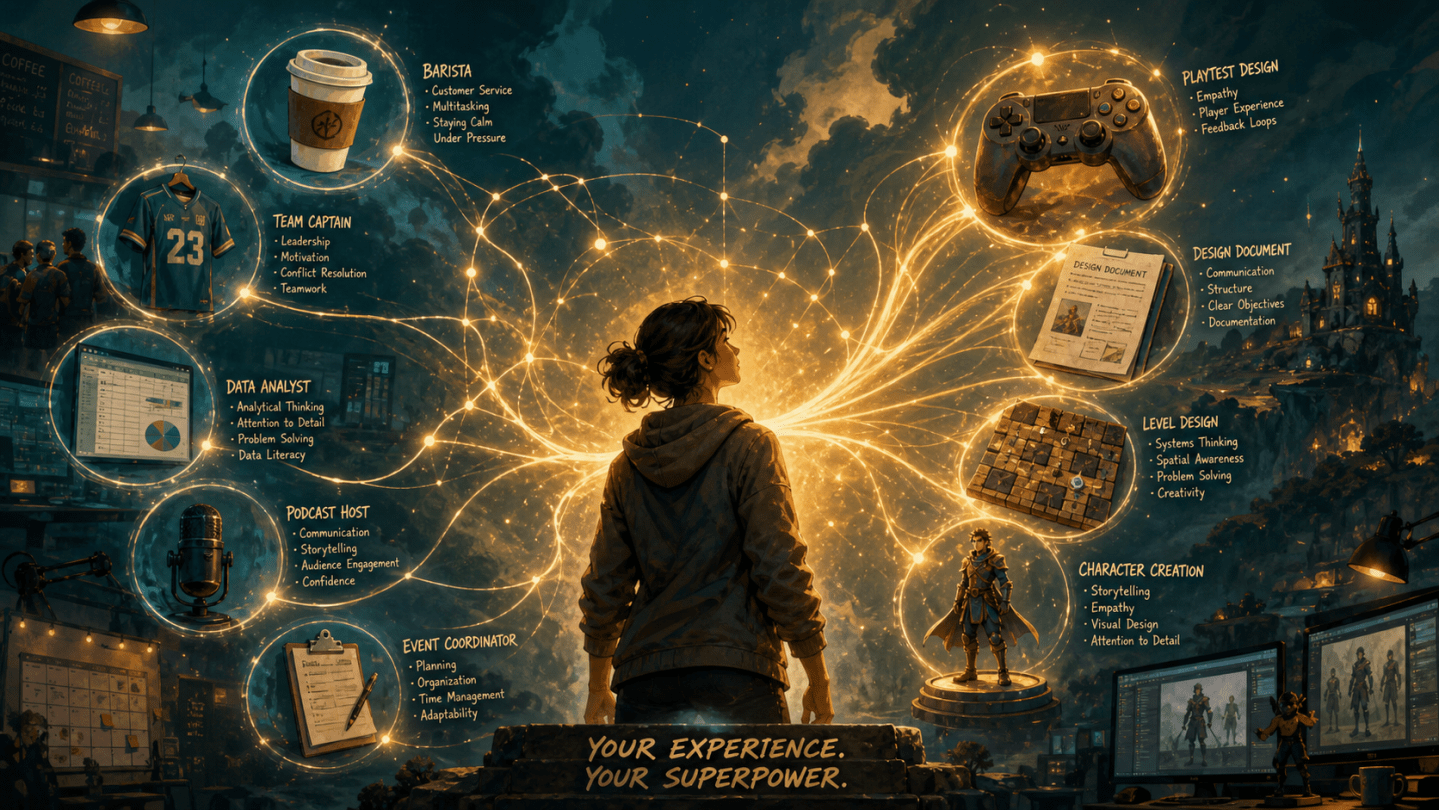
Every industry runs on a set of underlying professional capabilities — problem solving, stakeholder communication, managing constraints, creating systems, understanding users. Game development needs all of these. The question is not whether you have them. The question is whether you can see them clearly enough to articulate them.
This is what “laddering in” means. You don’t start at the bottom of a new industry. You find the rung you’re already standing on — and step across.
The Three-Column Skills Inventory
The most practical exercise I know for this is brutally simple. You need a blank page and about 20 minutes.
Draw three columns:
| What I’ve Done | The Skill It Proves | How It Applies in Game Dev |
|---|---|---|
| Your experience | The underlying capability | The direct connection |
Then fill it in honestly. Here’s what it looks like in practice for a few common backgrounds:
Retail or hospitality:
You managed frustrated customers in real time, often with no script and no backup. That’s user experience research and player onboarding design. A player who quits in the first 30 seconds because the tutorial is confusing is the same problem as a customer who leaves because they couldn’t find what they needed. You already know how to solve for that.
Administrative or office roles:
You documented processes, managed competing priorities, kept records, and communicated status updates to people who didn’t have time for detail. That’s game design documentation, project scoping, and stakeholder communication — the backbone of ICTGAM422 and every professional game project.
Team sport:
You performed under pressure as part of a coordinated group, adapted when the plan fell apart, and found ways to contribute when your role wasn’t clearly defined. That’s agile game development — sprint production, cross-functional collaboration, and shipping under a deadline.
Content creation (YouTube, TikTok, Twitch, writing):
You researched an audience, created something for them, published it, read the feedback, and iterated. That is the entire game development loop, applied to content instead of a game. You already know how to build for an audience.
My Own Rung on the Ladder
When I moved from being a software developer into business analyst and eventually into Data and AI Governance, I didn’t start over. I translated.
I had spent years building frameworks that structured complex information into clear, governed ways — defining what data meant, who owned it, how it moved, and what happened when it broke. When I developed DASUD (my AI governance framework), I wasn’t learning a new skill. I was applying the same capability to a new domain: designing a structured system with clear rules, lifecycle stages, and accountability.
In game development terms, that’s exactly what a game design document is. It governs what the game is, what it isn’t, how its systems interact, and what the rules are. The domain was new. The thinking was the same.
That realisation — that my skills were portable, not obsolete — changed how I talked about my work. And it will change how you talk about yours.
Why This Matters for How You Present Yourself
The games industry, like most creative-technical industries, has a tendency to overvalue formal credentials and undervalue demonstrated capability. That’s starting to change, but slowly.
What closes the gap is your ability to name what you bring in language the industry recognises. Not “I’ve worked in retail.” But: “I have five years of experience managing real-time user experience problems under pressure, which is directly relevant to player onboarding and retention design.”
Same experience. Completely different signal.
This is not spin. It’s translation. And it’s a professional skill in itself.
Practical Tips: Build Your Skills Inventory This Week
1. Fill out the three columns for at least five experiences.
Don’t filter yourself. Include paid work, volunteer roles, sport, content creation, caregiving, gaming itself. All of it is evidence of something.
2. Ask someone who knows your work to read column two.
Other people often see your capabilities more clearly than you do. Show someone your “skill it proves” column and ask: “Is there anything missing? Anything you’d describe differently?”
3. Translate one skill into a LinkedIn bullet point.
Take your strongest row and write it as a LinkedIn profile bullet: “[Skill] applied to [context], resulting in [outcome or capability].” That’s your first piece of translated evidence.
4. Research three junior game dev job postings.
Read the requirements carefully. Then go back to your three-column inventory and map what you have to what they’re asking for. You will find more matches than you expect.
5. Build the habit of naming skills in real time.
Next time you solve a problem at work, in a team project, or in a game jam, pause and ask: “What professional capability did I just use?” Name it. Write it down. Your inventory grows every time you do this.
The Bigger Picture
The game industry doesn’t need you to be someone else. It needs you to understand what you already are — and to be able to say it clearly. Your background is not a liability to explain away. It is a differentiator to lead with.
In the next post, we go deeper into Tool 3: how to make that evidence visible to the world by building a professional portfolio — and why sharing your process publicly is more powerful than waiting until everything is perfect.
This post is part of a five-part series on the professional tools every game developer needs — whether you’re leaving school, changing careers, or ready to take your first project from idea to greenlight.

