 Written by
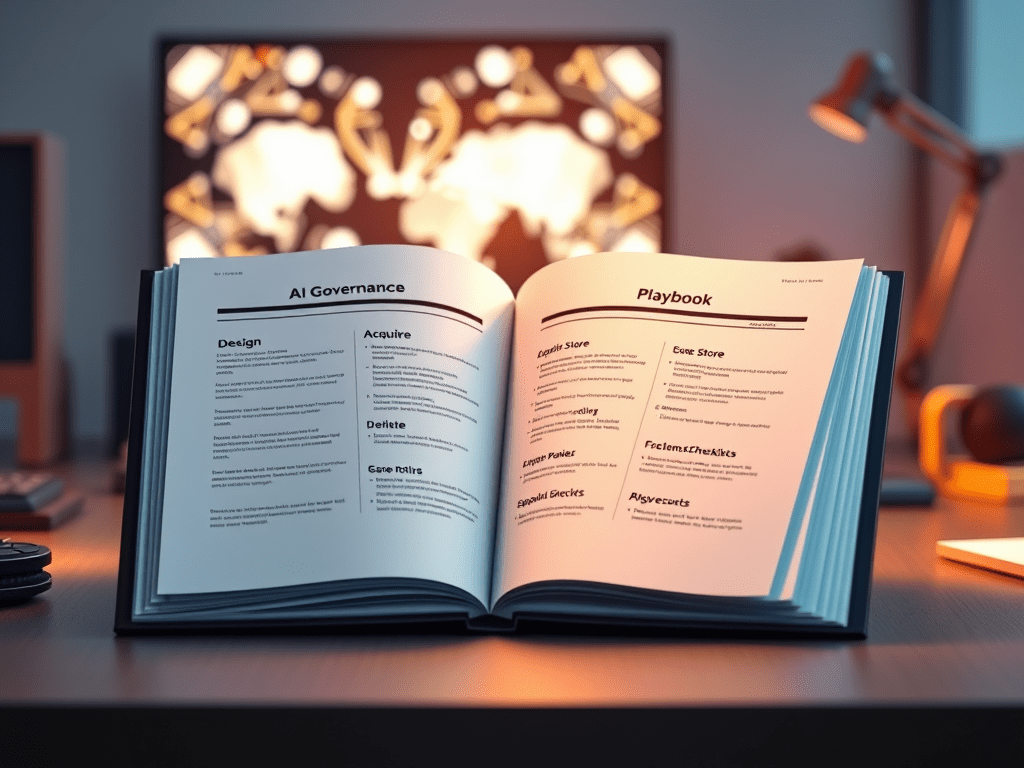
 By this point, you probably have pieces of an AI governance approach: risk questions, design checklists, prompt guidelines, RAG source lists, agent charters. The problem is that they live in different places, formats, and people’s heads. A playbook brings them together into something teams can actually use.
Think of it as a “how we do advanced AI safely here” manual, anchored on DASUD.
Decide what your playbook is (and isn’t)
Your playbook should be:
- Practical Focused on how to do things, not just why they matter.
- Modular Easy to dip into for a specific task (e.g., “design a GenAI use case”).
- Minimal Include just enough detail to be useful; link out to deep reference material.
It shouldn’t try to be:
- A full textbook on AI.
- A repetition of every policy in your organisation.
- A static, unchangeable document.
It’s a routing and template hub.
Structure the playbook around DASUD
Use DASUD as your table of contents. For each stage, include:
- Design
- GenAI use‑case design template.
- RAG design sheet.
- Agent charter template.
- Oversight mode (HITL/HOTL/auto) decision guide.
- Acquire
- Data and fine‑tuning checklist.
- RAG source/knowledge repository intake form.
- Agent tools/APIs risk classification template.
- Prompt library governance rules.
- Store
- Logging and storage matrix (what’s stored where, for how long).
- Memory governance checklist for agents and GenAI.
- Access control and segmentation guidance.
- Use
- Allowed/prohibited use guide for GenAI tools.
- RAG “who can ask what” patterns by role.
- Agent tool‑use capability catalogue template.
- Oversight workflow patterns (HITL/HOTL examples).
- Delete
- Model and feature decommissioning checklist.
- RAG content update/deletion procedures.
- GenAI history/memory deletion/reset patterns.
- Kill‑switch and rollback playbooks.
Make each section no more than a few pages, with the emphasis on templates and examples.
Prioritise templates over prose
Teams under pressure want tools, not essays. For each priority area, provide:
- A one‑page checklist.
- A form or canvas they can fill in.
- An example filled‑in version from your context.
For example:
- “GenAI design canvas” Sections for purpose, audience, risk level, oversight mode, red‑lines, allowed content, and disclaimers.
- “Agent charter template” Mission, in‑scope and out‑of‑scope tasks, tools, escalation rules, and success measures.
- “RAG source intake form” Repository name, owner, sensitivity, in‑scope/out‑of‑scope tags, indexing patterns.
These become the working artefacts of your governance process.
Make the playbook discoverable and owned
A playbook nobody can find might as well not exist.
- Host it in a central, easily searchable location Intranet, knowledge base, or internal developer portal.
- Assign ownership Someone (or a small team) is accountable for maintaining and updating it—likely your AI governance lead or an extended data governance function.
- Communicate it Refer to the playbook in training, project kick‑offs, and approval processes. Make it the “one place to start” for AI work.
Iterate with real use
As teams use the playbook:
- Collect feedback on what’s confusing or missing.
- Add examples and refinements.
- Retire sections that aren’t used, or fold them into simpler templates.
Your playbook should reflect how your organisation actually does AI governance, not just an aspirational design.
Make it concrete
To start:
- List the templates you already have (even in rough form).
- Fit each into a DASUD section.
- Identify 2–3 gaps where a simple template would unlock a lot of clarity (e.g., agent charters, RAG design sheets).
- Assemble version 1.0 and test it with one AI project from start to finish.
This playbook becomes both a practical tool and a visible artefact of your leadership in advanced AI governance.
If you’d like assistance or advice with your Data Governance implementation, or any other topic (Privacy, Cybersecurity, Ethics, AI and Product Management) please feel free to drop me an email here and I will endeavour to get back to you as soon as possible. Alternatively, you can reach out to me on LinkedIn and I will get back to you within the same day!
 Nigel D'Souza