
 Written by
 After years of hard work, and rigorous testing across 3 industries (and counting) I’ve created a framework that has helped launch Data Governance in the shortest amount of time. There are multiple frameworks out there (to meet any need you may have), and often, it requires a bit of existing knowledge before you can even consider how you apply it. The goal with DASUD, is to help you launch your own flavour of Data Governance within the shortest period of time – which, at current publication is under 6 months. By contextualising your needs to the DASUD framework, I am confident that it will be your launching pad into something greater that not only becomes your flavour of a Data Governance Model but something that lasts long after you have moved onto your next challenge!
Pre-requisites
As with all good Data Governance programs, you will need to ensure you have done the foundations before you start implementing DASUD. These include:
- Defining the Roles and Responsibilities
- Having a classification process
- Having an approval process: Working Groups > Data Governance Council > Steering Committee!
- Top issues that are prioritised from within the business [this can be a challenge in and of itself]
- Willingness and Urgency to change – think culture change.
The 5 Questions
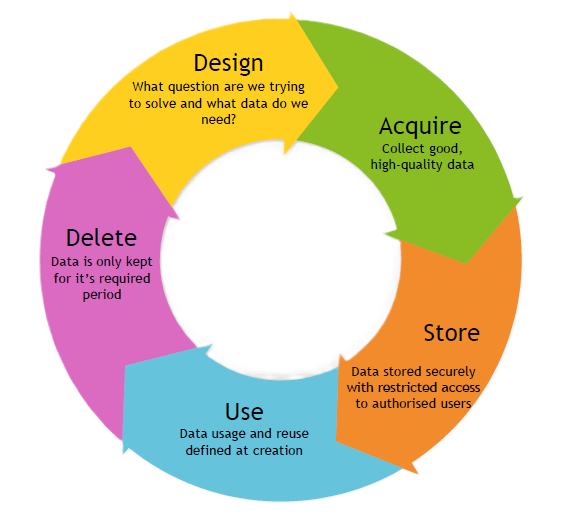
At the heart of the framework, DASUD stands for Design, Acquire, Store, Use and Delete. When it comes time to data collection and it’s use, you need to answer 5 basic questions:
Design:
What is the minimum data you need to collect to answer the question you’re trying to solve?
Acquire:
How do you collect good quality data? Now quality can be defined in multiple ways, however, I recommend you find a few (3 is always a good start) to adhere to. My top 3 has always been: Complete > Accurate > Consistent.
Store:
How will you store your data securely whilst ensuring only approved users gain access to it?
Use:
How will you ensure that your data will only be used for the purpose for which it was collected?
Delete:
When will you delete the data you no longer need?
Regardless of the context, answering these 5 basic questions will take you a long way to answering any of your data needs. This framework has been validated in Publishing/Education, Retail and Medical Research. It was developed by intersecting my love of Product Management and Data Management!
Principles Based Approach
The way to implement this framework is by approaching each segment with principles focused on legislation that contextualises it for your needs. I’ll cover the medical research case study and then various examples as needed.
For more details on the blueprint behind implementing a good data governance program – click here!
If you’d like assistance or advice with your Data Governance implementation, please feel free to drop me an email here and I will endeavour to get back to you as soon as possible. Alternatively, you can reach out to me on LinkedIn and I will get back to you within the same day!
 Nigel D'Souza
2 comments